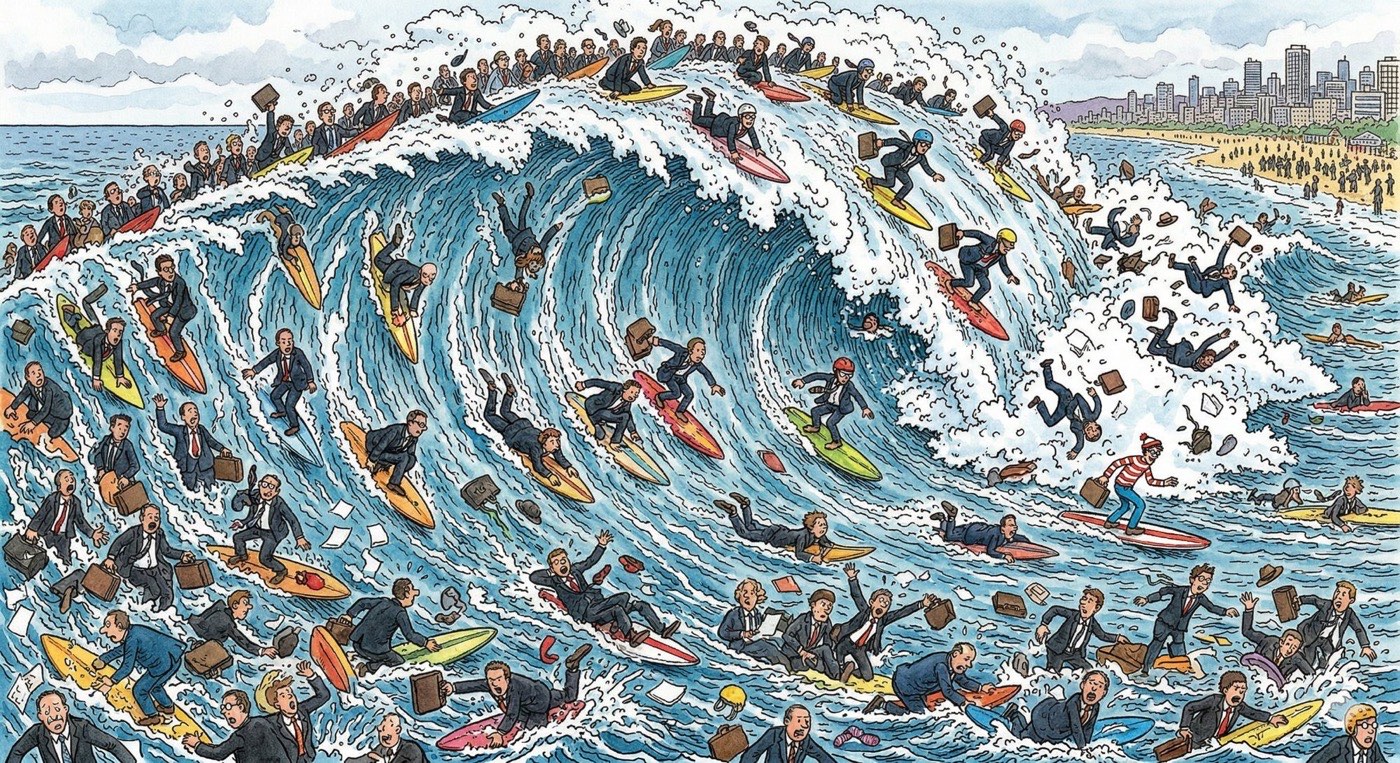
From my NYU Stern talk, “The Wave Is Coming.”
In 2023, GPT-4 came out and I realized it could write code. It was the first technology that ever scared me. So I learned to build with it.
That is the whole move.
You cannot fight a wave. You cannot vote it down, schedule it for next quarter, or wait for it to be convenient. What you can do is read it and get into position. Everything I have learned running AI inside a large company comes back to those two things.
Reading is not predicting. Nobody knows where this lands, and the people writing confident eighteen-month roadmaps are guessing. Reading is a practice. I keep personal subscriptions to all the frontier models and use them every day. I read the engineering blogs from Anthropic and OpenAI the week they post. I test every new feature myself. And I have a small group of friends who build, and we tell each other what is actually working. That is how you see what is breaking, this month, before it shows up in anyone’s plan.
Positioning is what you do with that. We did not build the platform first and wait for the org to catch up. As each new model landed, we shipped on top of it: JLL GPT in 2023, Falcon in October 2024, agents now. We stayed out on the frontier and built the platform behind us as we went: the gateways that route across models, the connections into real data, the safe paths everyone else could follow.
You do not do this once. The work is continuous iteration: ship, watch what happens, adjust, ship again. I am suspicious of any AI plan that has a finish line.
I build the same way I read: on the newest tool the day it ships. I run fleets of agents in parallel instead of babysitting one. I point Claude Code at the MCP tools I am building and let it fuzz them until the bugs fall out. The long-running agents live on a dedicated box, not my laptop. I write more code now than I ever did as a full-time engineer. Last year I opened more than two hundred and fifty pull requests on my open-source projects alone, and more on the ones you cannot see, and I have not written a line of it by hand in years. I lead the AI platform at a Fortune 200 company. I built and grew the team behind it, and I drive the work across product, engineering, design, security, and legal, most of it without direct authority, for a platform that fifty thousand people use every month and twenty-five thousand every day. You cannot lead this work without doing it.
The most common mistake I see is treating AI like a purchase. Pick a vendor, sign the contract, roll it out, declare victory. That is procurement, and it is the wrong playbook for something that changes every month.
The right playbook is the one I learned from a startup we acquired, a team that came up through Y Combinator. Marty Cagan on product discovery and Shreyas Doshi on product thinking are both worth reading. Obsess over your first users. Ship fast enough to keep them. Fight toward product-market fit one release at a time. Run each agent that way: it earns its place with real users, or you kill it. Counting agents is a vanity metric. The one that matters is the one nobody can imagine working without.
The thing that makes an agent useful is the same thing that makes it dangerous. We built Pulse, an agent that reads your work context: your email, your calendar, your files, your chats, the meeting transcripts. Ask it to prep you for your two o’clock and it pulls the deal history, the thread you forgot, the document someone dropped in chat last week. A thousand people at JLL use it. It is useful because it can see everything. That is also exactly what leaks your credentials, or surfaces a file to someone who should never have seen it, the moment no one is governing it. So we built the governance into the platform before the feature, and we made expensive choices to do it. The agent acts with your delegated permissions and nothing more. It never stores your tokens and keeps no copy of your data. Anything it reads, an email, a chat, a transcript, comes back to it as a tool result, never as instructions, so a malicious message cannot hijack it. Destructive actions take an unskippable confirmation that explains, in plain language, what is about to happen. Its tools only reach inside our network, with discovery turned off. We turned off capabilities people asked for and gave up features we wanted, because the safe version could not do them safely. Reading the opportunity without reading the risk is how you get hurt.
Everyone talks about the floor rising. The real story is the spread. The fastest people, accelerated by these tools, now do alone what used to take a team: the product, the engineering, and the design, in one person with no handoffs. And teams carry a hidden tax. Every person you add multiplies the communication links between them, and that coordination is pure overhead. When your best people move ten or a hundred times faster, a one-times contributor starts to cost more than they add. Talent will concentrate toward the people who produce, especially at mature companies. I think that is one of the real risks of this shift, and it is a prediction I will stand behind.
3 people · 3 links
5 people · 10 links
10 people · 45 links
None of this is a skill you reach and keep. The only edge that lasts is absorbing each new capability as fast as it ships.
Every few months, something changed how I work
- Mar 2023 · GPT-4
- 2023 · Cursor
- Mar 2024 · Claude 3
- May 2024 · GPT-4o
- Feb 2025 · Claude Code
- Apr 2025 · Codex
- 2025 · GPT-5 · Claude 4 · Gemini 3
- 2026 · A new flagship almost every month
Talk to people. Manage agents. Do things in the real world. That is the future of work. Everything else is getting automated. I know, because it already happened to me.